8. Calendar & Scheduling (Pro)
Schedule jobs, manage your calendar, and optimize daily routes.
Note: Calendar features require an active Pro subscription.
🇪🇸 ¿Prefiere español? Calendario y Flujo de Trabajo — Guía de inducción.
8.1 Calendar Overview
The calendar helps you manage your schedule, track job appointments, and plan installations.
Access: Go to More > Calendar.
Calendar Views
| View | Description |
|---|---|
| Day | Detailed view of a single day's events |
| Week | Weekly overview with time slots |
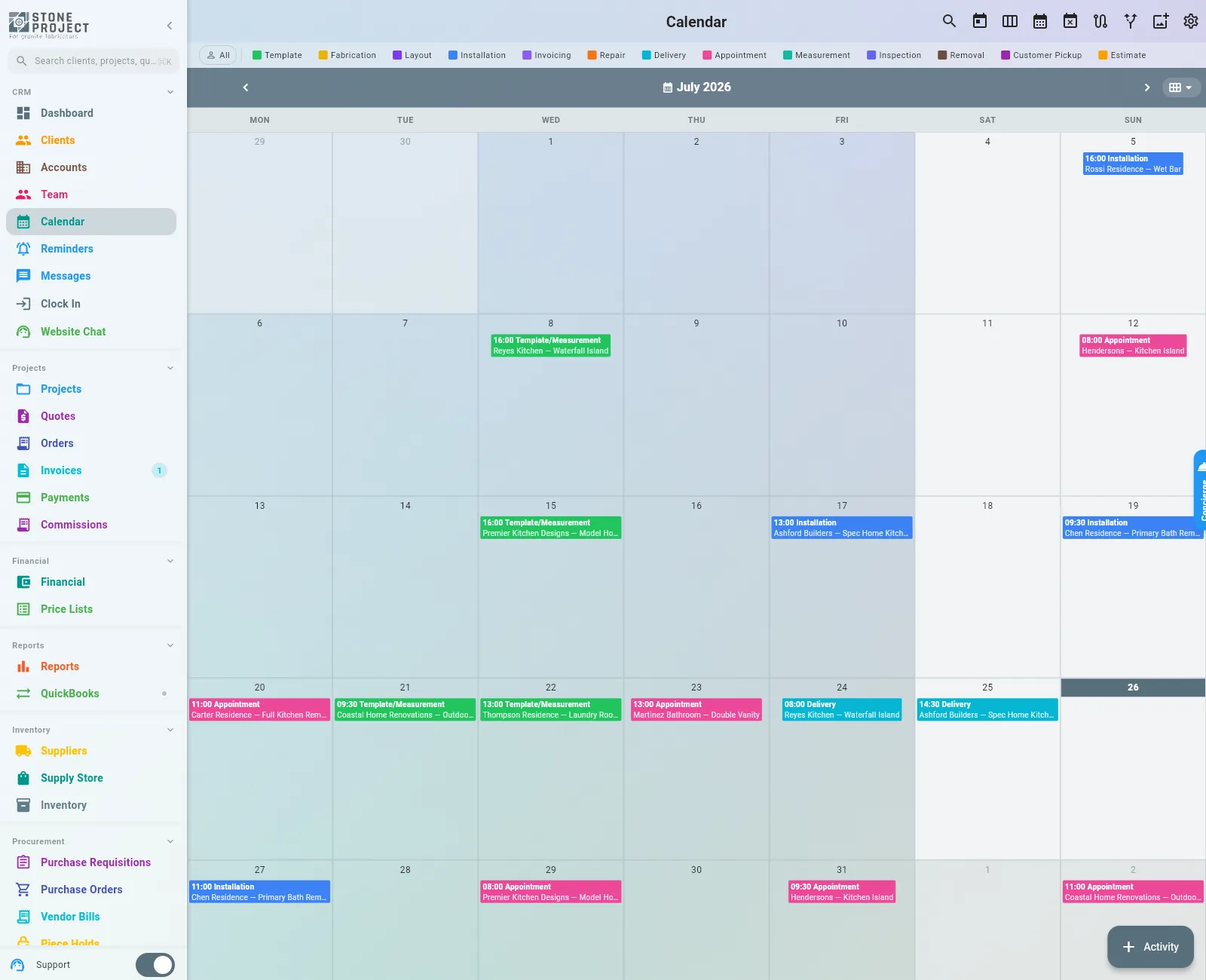
| Month | Monthly calendar with event indicators |
Tap an activity to open it. To create one, tap + Activity (bottom right).
The preview that opens has the crew's time buttons, so a field visit runs from the calendar without opening View Details: Start Work before the job (it checks the crew in), Pause and Complete Job while it runs, Resume after a break. Milestone steps with time tracking off (Paperwork Released, CAD) close from the status chip at the top instead.
Square footage for a week
The ruler icon in the Calendar toolbar (Daily Workload) totals the square footage scheduled in the period you are looking at.
- Open Calendar and move to the week you want (the arrows, or the calendar icon to jump to a date).
- Tap the ruler icon in the top bar. On a phone it is under the more menu, labeled Daily Workload.
- The screen opens on that week. The card at the top is the week: template, installation, the total, and how many stops. Each day underneath is the same split. The total counts each job once a day, whatever stages it has that day, and leaves repair visits out.
- The arrows move one week at a time. Week and Month switch the range.
The footage comes from the drawings on the jobs booked those days. A job with no drawing is listed and adds nothing, so a day that reads 0 sq ft can still have work on it. This is scheduled footage. Footage you have sold is Reports → Sqft Sales, where Week or a custom date range picks the period.
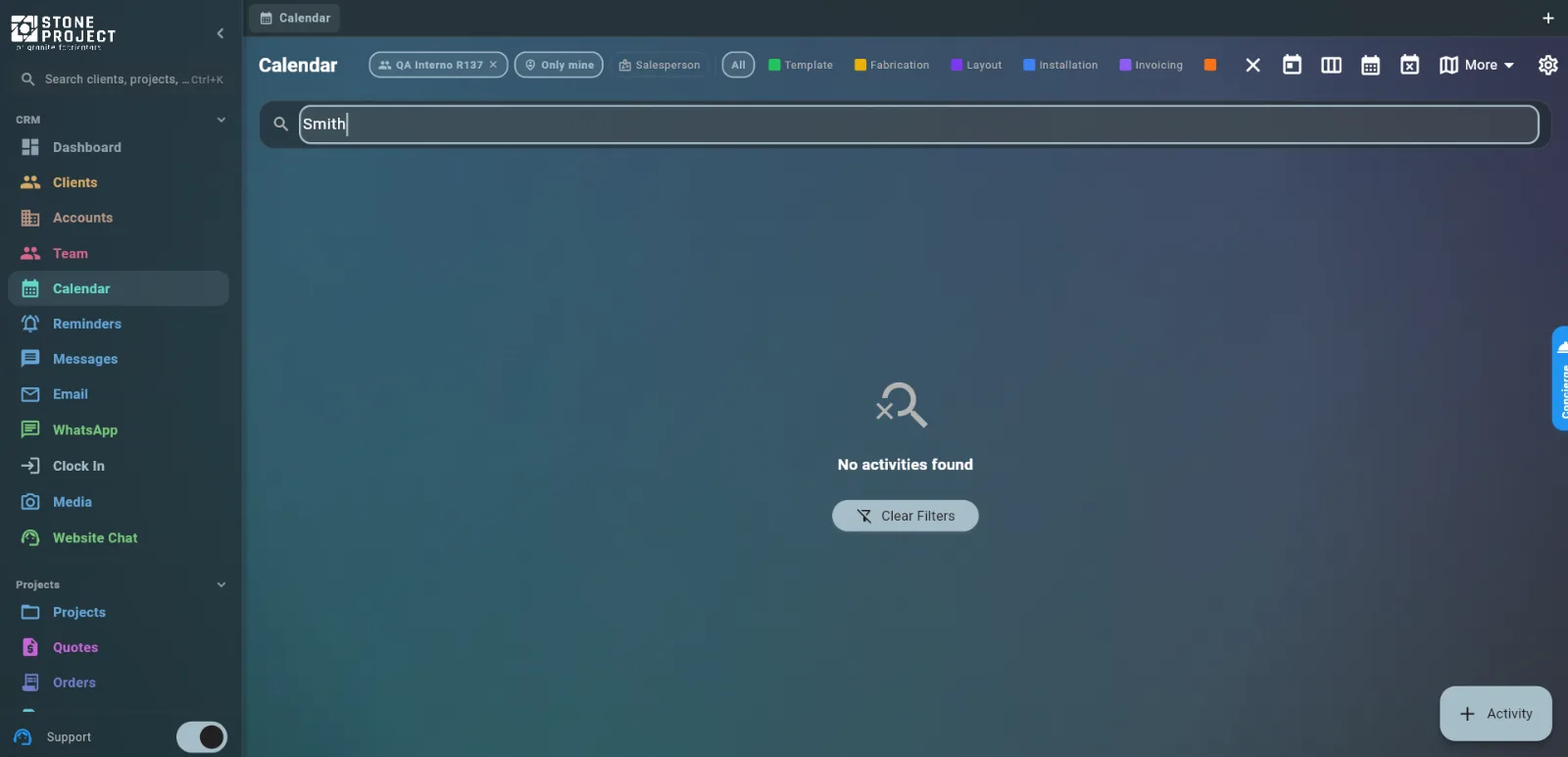
Searching for a job (and why it says "No activities found")
Tap the magnifier in the Calendar's top bar and type at least two letters: the client's name, the address, the job or the crew. The search looks at every date, not only the week on screen.
The chips next to the title still apply while you search:
- All / Only mine: Only mine shows just the activities you are on. The app remembers it on this device, so if you turned it on yesterday it is still on today.
- A chip with a person's name and an x: the calendar is showing only that person's activities. Tap the x to drop it.
- Salesperson and the colored activity types (Template, Fabrication, Installation...): each one you pick narrows the list.
So when the search comes back empty, the job usually exists and a chip is hiding it. Tap Clear Filters under "No activities found": it turns off every chip at once and runs the same search again.
If the empty result says "You only see activities assigned to you", it is not a chip. Your login is set to see only the activities where you are the responsible person or a participant, and Clear Filters cannot change that. Two ways out:
- Ask whoever schedules the job to add you as a Participant on the activity. It then shows up in your calendar and in the search.
- Ask an owner or admin to open Team, tap the ⋮ on your row, choose Edit, scroll down to Visibility and turn on See the whole schedule, then Save Changes. You will see every activity in the calendar while the rest of the app stays limited to your own jobs. Turning off See only assigned items removes the limit everywhere.
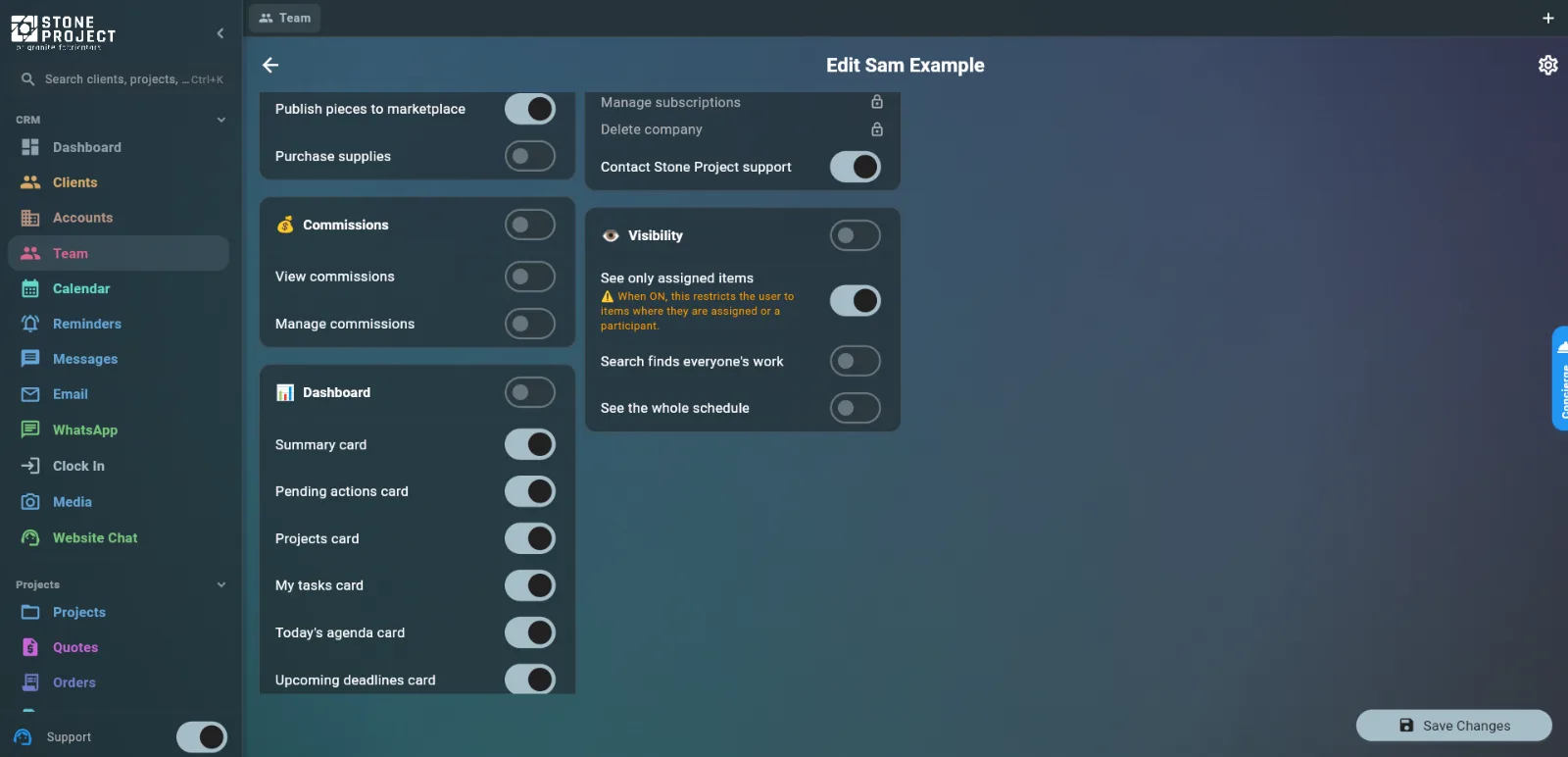
The roles Member, Fabricator and Sales start with See only assigned items on, which is why a new installer or a shop tablet logged in as a fabricator "cannot find" jobs that the office sees. Search finds everyone's work opens the search at the top of the menu (clients, projects, invoices) to the whole company; it does not change the Calendar.
8.2 Creating Events & Jobs
New Activity
- Tap + Activity on the Calendar (or + Schedule in a job's Schedule section, which links the job for you).
- Fill in:
| Field | Description |
|---|---|
| Activity Type | Template, Installation, Repair and so on (list below) |
| Project (Optional) | The job this visit belongs to, so it shows in the job's schedule and can move its stage |
| Date | Or tick No date yet, schedule later to keep it on the job without a day |
| Time (Optional) and Duration | Start time and how long it takes; empty time = all day. Warnings show for holidays, days off and hours outside work time |
| Participants | Team members on the visit; they get the notifications and reminders |
| Address (Optional) | Leave empty to use the job address |
| Notes (Optional) | Access instructions, details for the crew |
- Tap Create. To book several visits at once (template, cutting, install), use Apply template with a schedule template.
Activity Types
New shops start with these types (add your own in Settings → Activity Types):
Template, Measurement, Estimate, Appointment, Layout, Fabrication, Delivery, Installation, Removal, Repair, Customer Pickup, Invoice.
Custom activity types
The built-in list is not the whole story. Settings → Activity Types is where you add types your shop actually runs — for example Removal and Template, when the crew pulls the old tops and templates in the same visit.
On each custom type, Counts as tells the project which built-in visits that type already covers. Tick Template and Measurement on a Removal and Template type, and a scheduled visit of that type clears the "Measurement not scheduled yet" alert. You should not also book a separate Template/Measurement for the same job.
That mapping lives on the activity type, not on the workflow stage. There is no separate setting for "which types count as a measurement" beyond those flags.
8.3 Route Planner and the Map
Two buttons in the Calendar toolbar answer the two questions crews ask: where are we that day and in what order do we go.
Map — where the work is
Tap the map icon in the Calendar toolbar. It plots the jobs of whatever you are currently looking at — the day, the week — as pins, split into two groups you can show or hide:
- Template/Estimate
- Install/Repair/Removal/Delivery
This is the answer to "a customer wants a template in Worcester, when are we near there?" — open the week, look at the pins, and tap one to open the job. Only jobs with an address on them appear.
Route Planner — the order and the miles
Tap the route icon (the one that looks like a fork in the road) in the Calendar toolbar, or go to /route-planner.
- Each route is a column of stops in order, A, B, C. Drag a stop to reorder it, and the distance and travel time recalculate as you go.
- Unassigned is the column on the left, holding the jobs nobody is on yet. Drag one onto a route to add it, at the position that makes sense for the miles.
- Optimize route reorders one route into the shortest sequence for you; Best route of the day does it across the day.
- Filter by user narrows the board to one crew. Show map / Show list switches how you look at it, and Navigate hands a stop to your phone's maps app.
- Events without address are listed separately — they cannot be routed until someone fills in the address.
Cancelled Activities and Jobs on the Route Planner
When a scheduled activity or job is cancelled, it immediately leaves the driving route:
- Automatic removal: Cancelling a scheduled activity (such as an install, template, or repair) automatically drops its stop from the assigned crew's daily route. The route's travel time, total mileage, and stop sequence update immediately.
- Cancelled jobs: Marking a job as Cancelled or Lost cancels its active scheduled activities, which automatically drops all associated stops from the Route Planner board.
- Reopening a cancelled activity: If you tap Reopen activity on a cancelled activity, the activity is restored to the schedule and appears in the Unassigned column on the Route Planner for that date, where it can be dragged back onto a crew's route.
Which Activities Appear on Routes
Only on-site visits to the customer's property appear on the Route Planner:
- Routable activities: Template, Measurement, Estimate, Inspection, Installation, Repair, Delivery, and Removal.
- In-shop activities: Fabrication, Slab Layout, Invoicing, and Customer Pickup happen at your facility and are excluded from road routes by default (unless your company has specifically enabled pickup routing).
- Missing pins or stops: Every stop requires a physical address with valid GPS coordinates. If an activity or job lacks an address, it will appear under Events without address on the left column and cannot be placed on a route until the address is entered.
8.4 Time Clock
Track your team's work hours with the built-in time clock:
- Tap the Time Clock button on the main screen (or from the Calendar).
- Tap Clock In to start tracking time.
- Optionally link the time entry to a project or activity.
- Tap Clock Out when the work session ends.
Off-Schedule Clock Events
If a team member clocks in or out outside their work schedule (beyond the tolerance), the app asks for a reason before recording it. Quick reasons are offered: when late, Traffic, Forgot to clock in/out, Client meeting, Emergency, Technical issue, Overtime, Other; when early, Arrived early, Task completed early, Meeting moved earlier, Released early, Emergency, Other.
If they were really on time and just forgot to punch, they tick I was on time, I just forgot to clock in/out. That sends the entry for review.
Clock Notifications
Clock In, Clock Out, Break Started and Break Ended notify the person who clocked. Managers are notified only when a review is requested (below): the member's designated clock reviewer if one is set on the member, otherwise every owner and admin. Tapping a clock notification opens the Time Clock screen; a review request opens the review list.
Time Clock Review (Pro)
Pro Feature
Time Clock Review requires a Pro subscription.
Managers approve the entries a member sent for review:
- Open Time Clock: a Pending reviews badge appears in the top bar when there is something to review (or tap the review notification).
- Each request shows the reason, the original check-in and check-out, and the photos.
- Approve keeps the times, Approve & correct lets you set the corrected check-in/check-out (with an optional admin note), Reject declines it.
Hours worked per person are on Team → Time Records, and scheduled emails of those hours on Team → Report Delivery (see Analytics > Time Clock Reports). Team-wide review and reports require Pro; clocking in and out works on all plans.
8.5 Workload and Crew Numbers
There is no separate productivity dashboard. The numbers live here:
- Daily Workload (ruler icon in the Calendar): square footage and stops booked per day, week or month (see 8.1).
- Reports → Activities: activities by type and status in the period, and return visits by installer.
- Team → Time Records: hours actually worked per person.
8.6 Automatic Scheduling
Pro Feature
Calendar automation requires an active Pro subscription.
There is no "Suggest Time" button. The automatic part works on the activities a workflow stage creates for a job:
- Go to Settings → Calendar Settings.
- Turn on Auto Schedule Enabled.
- From then on, when a job moves into a stage that creates activities (Workflow Designer), the scheduler places each new activity in the best free slot it finds for its duration, instead of the fixed time set on the stage. Activities you create by hand keep the date and time you pick.
Keep unfinished work on today
By default an activity stays on the day it was booked, and once that day passes it shows as overdue. For work that runs over several days (a fabrication that takes a week, for example) you can have it follow you instead:
- Go to Settings > Calendar Settings (company scope).
- Under Move to today until completed, select the activity types.
- Tap Save.
Every morning, activities of those types that are past their day and not completed move to today (or the next open day), keeping their status, crew and time. They stop moving as soon as someone completes them. Activities created by a workflow stage have their own option, Auto-bump if not confirmed (in the Workflow Designer), which stops once the activity is confirmed.
8.7 Deadline Reminders
Stay on top of project deadlines with automated reminders:
- Open Reminders in the side menu (on a phone, under More).
- View upcoming reminders.
- Create your own with New Reminder.
Automatic Reminders
The system automatically generates reminders for:
- Project deadlines — Configurable days before the due date
- Quote expirations — When quotes are about to expire
- Activity reminders — 24 hours before a scheduled activity, and an alert when an activity is overdue
Daily Summary
Owners and admins get a daily summary push every morning (08:00 UTC) when there is something in it:
- Overdue jobs and jobs due today
- Quotes about to expire
- Quotes that need a follow-up
Nothing to report means no summary that day.
Configure reminder preferences in Settings > Notifications.
8.8 Activity Checklists
Add task checklists to scheduled activities:
- Open an activity.
- Scroll to the Checklist card.
- Type in Add item... (e.g., "Disconnect plumbing", "Remove old countertop", "Check level") and tap Add Item.
- Check off items as they are done on site. An item can also carry a note or a photo.
To make the checklist, a photo or a note mandatory before an activity can be completed, see the completion settings in Settings → Calendar Settings.
Linked to CRM
Activities linked to a job can move the job's stage when they are scheduled, confirmed or completed, following the auto-transition rules in the Workflow Designer. If a job "moved by itself", check those rules. See CRM > Kanban Board.
What the app asks after you complete a visit
Completing an activity can open the next step of the job, already filled in:
- Template or Installation completed, shop invoices by hand (Settings → Invoice Settings → Create invoices by hand only): the app opens the job's order and asks for its invoice, with Generate Invoice ready. After an installation it asks even if your shop waits for the order to be completed, because the field work is over. Shops with Weekly invoices for finished jobs are not asked: the weekly batch creates the draft.
- Active order with nothing left on the calendar: the order asks you to schedule the next visit for that client. A finished template with nothing booked after it still counts as "nothing scheduled"; a finished installation does not.
You can always skip the question; nothing is sent to the client until you send it.
Activity Photos
Document completed work by attaching photos to activities:
- Open an activity.
- In the Photos card, tap Take Photo or Choose from Gallery, and tag it Before, During or After.
- Photos stay on the activity record.